
Today I'm sharing an effective method for entrepreneurs and managers to make decisions, capable of accelerating your company's development and stopping missed opportunities.
According to a McKinsey survey[^1], the average company wastes €400,000[^2] annually in the decision-making process. In a manager's life, an estimated 13,000 hours[^3] are dedicated to useless decisions. That's 6 years of work!
Every poorly made decision lowers motivation and reduces leadership capability.
"The best leaders are those who, out of 10 decisions they make, 7 are good," my grandfather used to say.
...and to do that, you need to decide quickly, not aim for 10/10 perfection.
The reality is that the best leaders know how to make decisions quickly and don't waste opportunities on projects that don't add value. This set of results exceeds employee expectations and provides great visibility.
A leader who decides well knows how to guide the company to create valuable relationships with customers and better counter a complicated market like the current one.
Unfortunately, most directors suffer from a disease called decision paralysis.
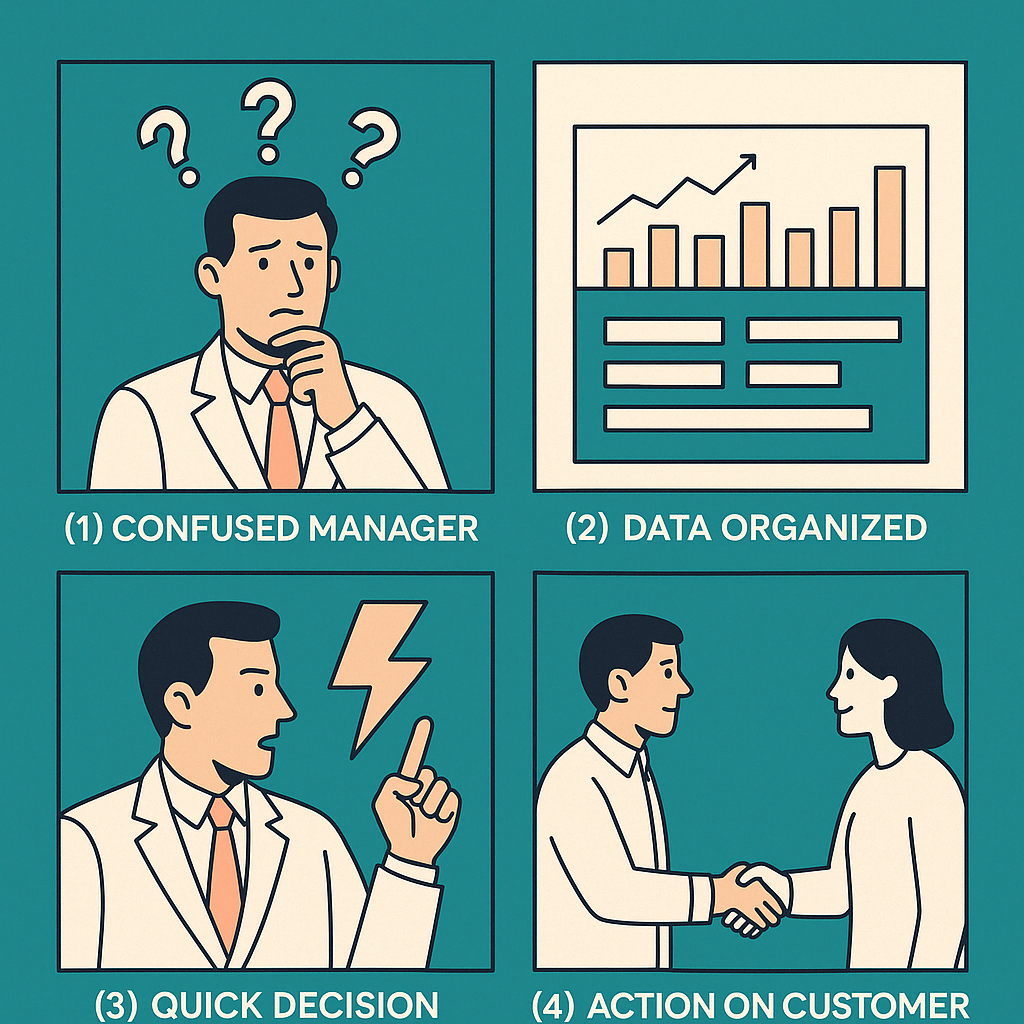
The decision paralysis that destroys companies' ability to grow
Leaders face daily problems that require immediate decisions. This phenomenon causes even the most robust companies to fail in their development projects. Want to know if your company has this disease? Ask yourself:
- Are you involved in useless meetings without a clear direction?
- Are there too many open initiatives limiting employees' time and energy?
- Do you see a lack of clear operational plans and control over decided actions?
If you answered yes to at least one question, I have good news for you: there's a way to regain control of the helm. It's called OODA and was developed by Colonel John Boyd[^4], a military pilot, to decide quickly and safely in contexts of high uncertainty and rapid change.
These decisions are 'zero-sum games', where one competitor succeeds at the expense of another's failure.[^5] It adapts well to geopolitical crises, customers who can't plan, and bureaucracy that slows things down.
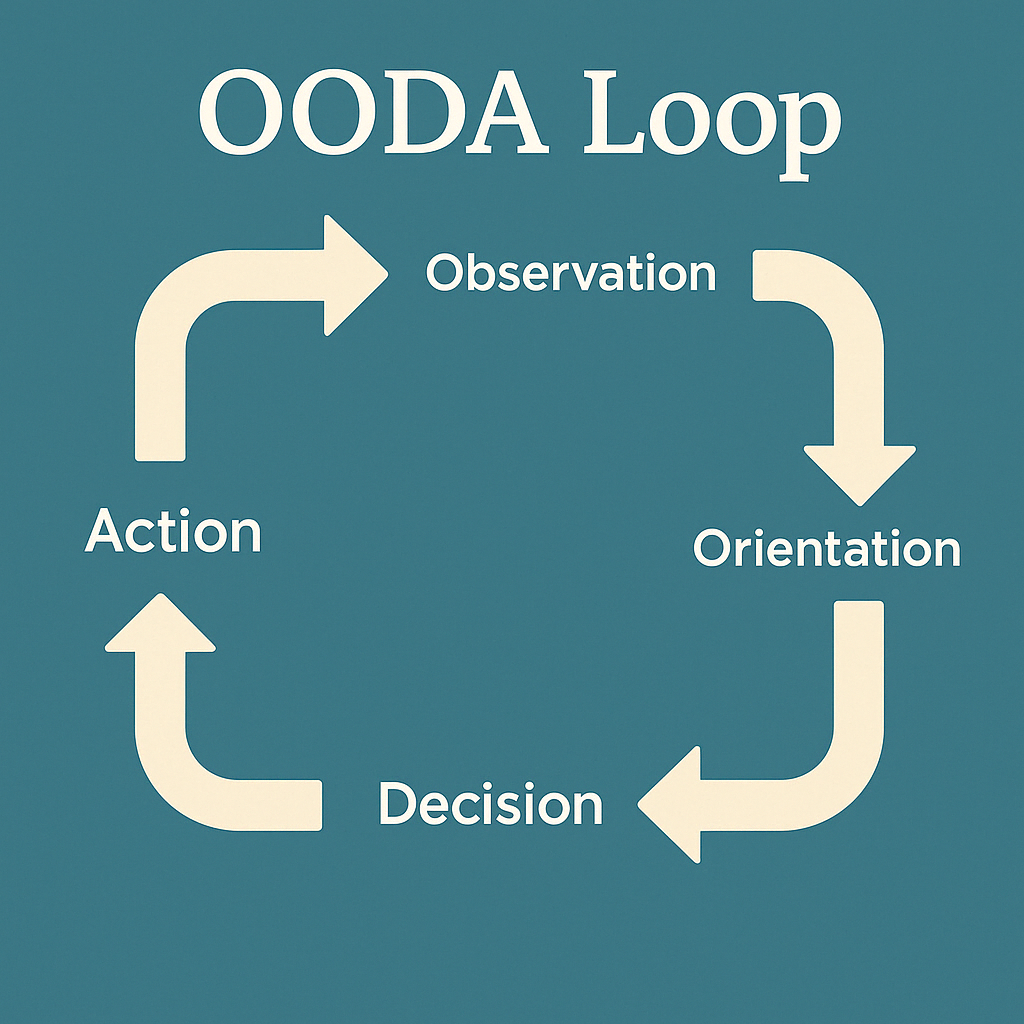
Here's how to do it in 4 steps:
Step 1: Observe
You can't win without knowing the battlefield: gather information on the key factors driving your business.
Specifically:
- Weekly monitoring of a few key KPIs, like sales, margins, cash flow, delivery times
- Simple post-sale customer surveys and analysis of quality issues
- Continuous listening to the sales network and "field" employees
Critical tip: dedicate 5 minutes each morning to the "flash report," use WhatsApp or Teams to get the day's data in the late afternoon and review it quickly.
Step 2: Orient
It's not enough to accumulate numbers; you must make sense of them concerning your strategy, culture, and lessons already learned.
Specifically:
- Compare the numbers with what's really happening outside your company: raw material indexes, bonuses impacting customers, etc.
- Simplify the direction to take into one sentence
- Review the data with your reports and compare it with the strategy to make sense.
- Prioritize
Ask yourself:
- A salesperson closing fewer contracts but with higher margins: is it a problem or progress?
- A peak in cash flow: is it seasonal or systemic?
- What would happen if the initiative failed?
Critical tip: focus on candid collaboration, use a whiteboard, and put post-it notes under 3 columns (data, reason, priority)
Step 3: Decide
Every decision eliminates all others; choose.
Specifically:
- Define a quick experiment:
- What can you achieve in less than two weeks?
- What will you do within 2 hours to make it possible?
- How will you measure progress tomorrow?
- Define who is responsible (one per desired outcome)
- Write the plan on one page
- What: new backup supplier in less than 5 days
- Who: purchasing department
- Next action: Google search and call the first 5 suppliers to find out what they do by morning.
- KPI: 2 quote requests with reduced average lead time
Critical tip: you don't need to be 100% convinced, and you don't need to convince everyone; it's not an irreversible decision, take it and test it immediately. 1 channel, 1 product, 1 target.
Step 4: Act
No battle plan survives contact with the enemy; decisions are worthless unless you execute and verify immediately.
Specifically:
- Choose the first task and act
- Don't let other urgencies divert attention from this task
- For delegated tasks, challenge collaborators and ensure continuous support
- Don't forget to check mid-experiment and at the end.
Critical tip: the most important part is reaching the end of the planned period and understanding how it went; feedback from results is crucial.
OODA: the accelerator of business scalability
True scaling occurs when the decision-making process no longer depends exclusively on the founder or senior managers.
The beauty of the OODA method is that it can be implemented at all levels of the organization, creating a distributed decision-making nervous system. As your company grows, decision-making bottlenecks become the main brake on scalability. When each team can operate with this autonomous yet strategically aligned decision cycle, your ability to scale multiplies exponentially.
It's no coincidence that companies like Amazon use variants of this approach[^6] to maintain startup agility despite being giants.
Start immediately with this tool
With the OODA method, you will not only drastically improve your decisions, but also:
- achieve in one quarter the number of experiments a company typically does in 3 years
- spend less to do more
- reduce the time needed to make decisions by 50% and dedicate the rest to building
- have a result guarantee at least 2.3 times higher[^7].
To help you implement this framework immediately, I've created the 10-Minute Decision Compass that you can start using today.
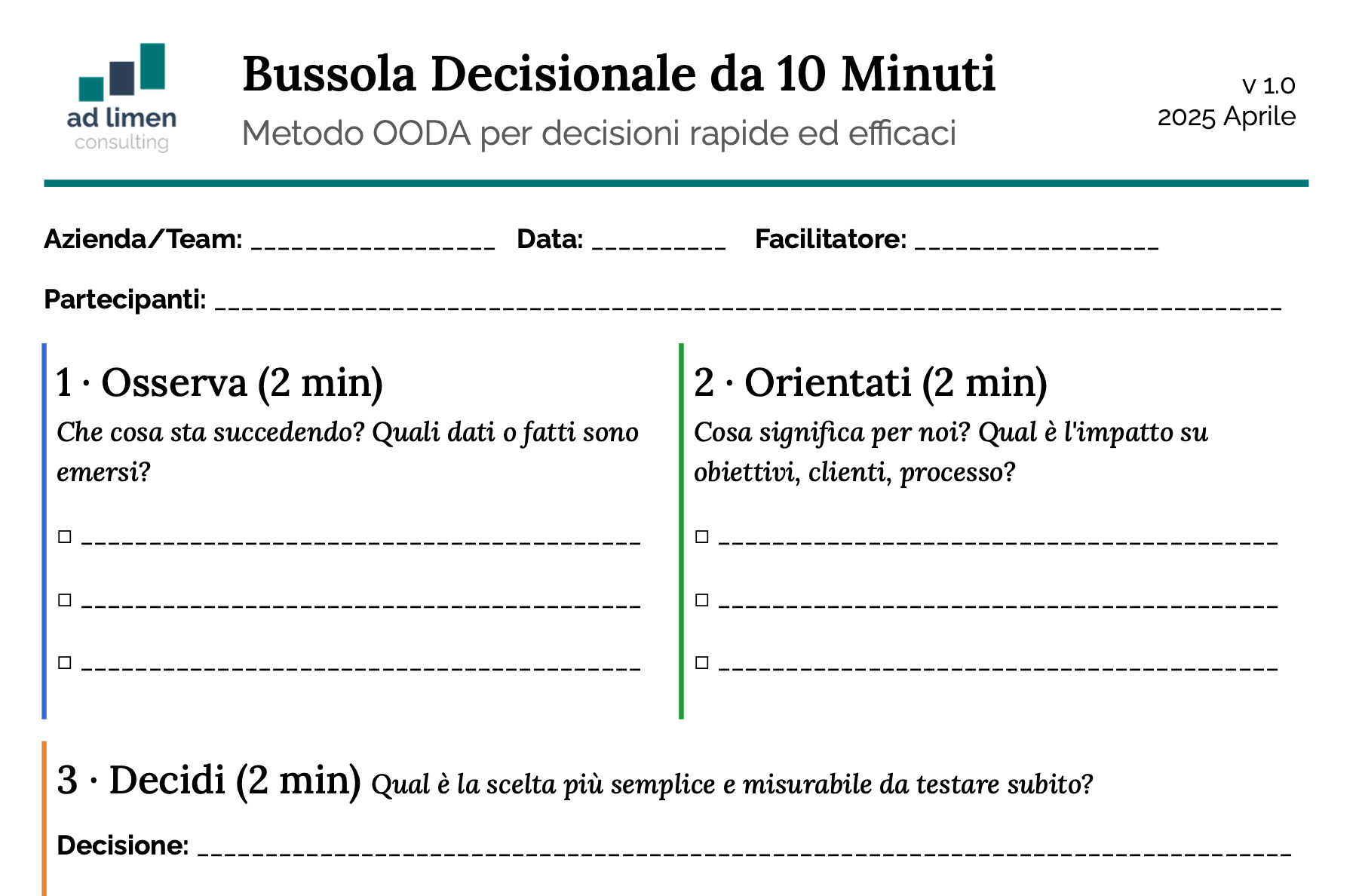
Decision Compass in 10 minutes
Discover how to make faster and better decisions with the Decision Compass in 10 minutes.
Download for FreeOODA: Observe, Orient, Decide, and Act to guide your company through the storm of the modern world.
Until next time,
Matteo
[^1]: Decision making in the age of urgency, McKinsey, 30 April 2019 [^2]: Based on the calculation: 30% of time spent on decision-making activities, of which 50% is ineffective. For 50 people (minimum for a medium-sized enterprise), that's 220 days x 8 hours x 50 people x 30% decision making x 50% wasted = 13,200 hours, valued at €30/h = €396,000 [^3]: 80,000 hours in a worker's life, 30% in meetings, of which 50% are useless = 13,000 hours [^4]: Colonel John Boyd (1927-1997) was an Air Force pilot during the Vietnam War, where he developed the OODA Loop decision model, and a strategic consultant to the Pentagon. [^5]: In game theory, "zero-sum games" are situations where the sum of players' wins and losses is always zero. In other words, what one player gains is exactly what another player loses. There is no possibility for players to cooperate and achieve a greater benefit for both. [^6]: Amazon uses the famous One-Pager to decide on complex projects. The OODA loop, broadly speaking, can be defined as an Action Learning or Design Thinking cycle. For further insights, I recommend this article. [^7]: See McKinsey survey, note 1