If your company has stopped growing, the problem isn't artificial intelligence or the global crisis.
Maybe the real issue is that you're missing the warning signs flashing right before your eyes. Business history tells us that devastating crises don't stem from external competitors or new technologies. Companies fall when they become trapped in protecting their own success.
This trap is called Experience.
In this article, I'll show you the 5 warning signs to understand if the past is secretly sabotaging your company's future too.
And also how to turn this threat into an opportunity before it's too late.
Why Experience is a Trap
A few years ago, early in my CEO tenure, the company I was about to lead was convinced everything was under control.
Declining results? Blame customers choosing lower-quality products and unwilling to spend. Certainly, it wasn't our fault. The company had forty years of experience and a solid reputation. What else could we do, right?
A painful loss of market share finally opened our eyes.
The organization had created a system toxic to innovation.
We held meetings where new proposals were systematically shot down with phrases like: "we've already tried that" or "our market is different." Fresh ideas were silenced, and the most vibrant talents weren't invited to participate, favoring those "with experience." The word "quality" meant "how we've always done it, unlike the competitors."
When a competitor ate our market share with a technology our technical system had dismissed as unsuitable, we lost 30% of our market value in less than eighteen months.
Then I understood that the problem wasn't external, but that our own, undeniable, competencies had turned into a trap.
Unfortunately, many CEOs and executives, just like us, fail to see these signs until it's too late. The wind changes, and the competitor's sail is already too far away.
The 5 Warning Signs That Foretell Disaster
- 1."Not Invented Here" Syndrome: When the organization systematically dismisses technical ideas from the outside, finding flaws and blaming the customer.
- 2.The Success Theater: When leadership only celebrates internal technical successes they sponsored and ignores customer failures or disparages proposals they don't deem valid.
- 3.Comparison Paralysis: When discussions focus solely on direct competitors, ignoring comparisons with different sectors because "you know, our market is different."
- 4.Innovation Subjugation: When innovation is praised in words, but in reality, the innovation department doesn't even have time for research because it's constantly putting out fires for urgent matters.
- 5.The Executive Echo Chamber: When Management only listens to agreeable opinions and constantly criticizes those not in the room or who disagree, often raising their voices.
If you find yourself facing any of these situations, stop and change your approach.
I realized I was trapped during a meeting in a room packed with people called to discuss yet another problem:
- 1.First off, the customer didn't understand anything.
- 2.Worse, they were guilty of not accepting our past proposals.
- 3."What if we did it like this other company?" "No, maybe it works there, but it's different for us."
- 4."The problem is we don't have an R&D department."
- 5."Alright, it's decided, now we'll commit and do it this way."
I stared at the ceiling tiles as people left the room with their notepads, but without a real plan.
But there's a way to take control. Here's how, in 3 steps:
Step 1: Learn to Recognize the Warning Signs
"Good companies fail not because they do the wrong things, but because they keep doing the things that made them successful for too long. The processes that once defined their capabilities eventually define their limits." —Clayton Christensen, The Innovator's Dilemma
Let's face reality: a good leader needs humility and must live with vulnerability. The biggest challenge is admitting that what worked yesterday might not work tomorrow.
Remember Kodak, the American company that dominated photographic film, wiped out by digital technology? Well, it was Eastman Kodak Company itself that invented the first digital camera in 1975. Executives were impressed but knew the company's profits came from the high margins on film rolls and didn't want to cannibalize their success.
Then Nikon and Canon arrived and revolutionized the market. When Kodak tried to jump on the technological revolution it had created but neglected in 2000, it was too late. In 2012, the company that had revolutionized photography with its slogan "You press the button, we do the rest" declared bankruptcy, a victim not of an inability to innovate, but of the inability to recognize when its own competencies had become a trap.
Don't be like Kodak:
- Continuously review the foundational elements of your business.
- Give voice to dissenting opinions within the organization.
- Observe new entrants in the market.
Questioning the status quo and experience must be encouraged and should not lead to negative consequences.
Step 2: Develop the Alert System
Once you start recognizing the signs, create a system to capture them promptly.
Safi Bahcall, in his book Loonshots, divides the organization between 'artists' who explore new ideas and 'soldiers' who manage the existing business. If you put ice next to water, it will eventually melt. When separation is lacking, short-term operational pressures will systematically kill the most innovative ideas, regardless of team quality.
Every time you complain about having incapable collaborators, you are likely mixing new ideas with daily operations, leading to a frustrated system.
- Calculate the average age of your flagship products and create strategies to reduce it.
- Initiate ongoing discussions with customers where criticism of current products is encouraged, assigning resolution to a product team separate from those managing operational quality.
- Create scheduled "innovation review" moments; bring young or disruptive individuals to the executive committee level to bridge the gap, giving them visibility to protect them in their daily roles.
The crucial point is that this system must have a direct line to the real decision-makers and must be shielded from short-term pressures.
Step 3: Launch Bold Campaigns to Challenge the Status Quo
I am a great admirer of Japanese corporate culture, the care they invest, and the society they are building.
In the Western world, continuous improvement often remains a mirage, requiring significant moments of organizational disruption—almost like self-cannibalization—to destabilize the status quo and enable action.
You have to break things.
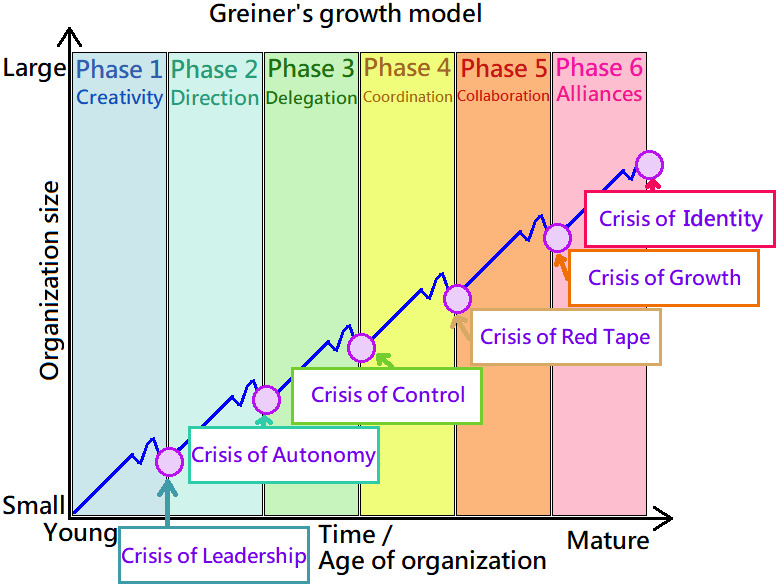 6 phases of organizational growth, Larry E. Greiner
Every period of evolution in a company creates a resolution. Ironically, the management practices that create success in one phase become the very elements that cause failure in the next. Yesterday's solutions generate tomorrow's problems.
Here's how to do it:
- Choose priority initiatives—few but significant—and communicate the direction.
- Gather a handful of talented people eager to emerge from various departments, assign them to projects, and protect their time.
- Assign and monitor challenges with short-term goals (max 2 weeks) to advance the initiatives.
The most difficult aspect is maintaining the balance between efficiently managing the current business and creating the future one; this is where a leader's true capability is measured.
Final Checklist
When people are given permission to innovate, not every attempt will succeed, but failing to embark on this path of breaking with the past will surely lead the company to decline.
The break will be more painful the more blocked and congested the company situation is.
Here are the key elements to put into play, in brief:
- 1.Recognize the warning signs that your company is stuck protecting accumulated experience rather than enabling innovation.
- 2.Create an alert system that allows for rapid action when signs are identified.
- 3.Use communication and planning to give innovation high visibility and importance.
Your role is to be a devil's advocate who constantly challenges the status quo. Don't cling to what you've built.
If you want to delve deeper into how to avoid the experience trap and build an organization ready for the future, measure your company's ability to scale with the ScalabilityScore:
Discover Your Scalability Score
Quickly assess your company's scalability potential through a structured test that analyzes the 12 key factors determining sustainable growth capacity.
Calculate Your Scalability ScoreBest,
Matteo.